One of the questions most frequently asked about aikido is whether it “works” in a real confrontation. It is an understandable question, but it is also incomplete. If we measure aikido only by whether a particular technique succeeds during a hypothetical street attack, we overlook much of what long-term practice is intended to develop.
Guillaume Erard addressed this subject thoughtfully in an interview excerpt he shared publicly on Facebook, originally published in Karaté Bushido No. 458. Erard is an experienced practitioner of both aikido and Daito-ryu aiki-jujutsu, as well as a teacher, researcher, and longtime resident of Japan.
I agree with much of his argument concerning the value and purpose of aikido. I disagree substantially with some of the political and social conclusions he draws from it. That disagreement does not prevent us from finding important common ground.
Martial Arts Guarantee Self-Defense?
A real assault is unpredictable. There may be no warning, no rules, and no opportunity to prepare. An attacker could be armed, accompanied by others, under the influence, or entirely unconcerned with personal safety. Fear and surprise may produce a freeze response even in someone who trains regularly.
At Kimusubi Aikido Orlando, we do not promise or guarantee personal safety. Our objective is to develop greater awareness of our surroundings, our behavior, and the developing conditions around us. Ideally, this awareness helps us recognize and avoid situations that we might otherwise have failed to notice.
Avoiding a dangerous situation is not a failure to use aikido. It may be one of the clearest examples of using it successfully.
Physical technique remains an important part of practice, but it should not be confused with an insurance policy. Training changes how we stand, move, observe, and respond. It does not make us invulnerable.
Martial Arts are Perishable Skills
Martial skills require continuous training. They are not like learning to ride a bicycle, where something learned in childhood can seemingly be recovered decades later with little preparation.
Timing, distance, conditioning, balance, sensitivity, and the ability to function under pressure all deteriorate without regular practice. Maintaining a genuinely high level of tactical readiness requires a considerable investment of time and energy. For most people managing careers, families, and ordinary responsibilities, maintaining that readiness indefinitely may not be practical.
Nevertheless, parts of the modern martial-arts industry encourage students to believe that completing a course or earning a rank gives them a lasting possession called “self-defense.” Once acquired, it supposedly remains available whenever needed.
That is not how martial ability works.
The belief that we are prepared for every confrontation can be more dangerous than recognizing our limitations. If our training leaves us with unjustified confidence, it may make us less cautious rather than more capable.
There is also a commercial incentive behind selling insecurity. Convince people that the world is constantly threatening them, convince them that they are unprepared, and then offer the product that promises to remove their fear. This may be modern marketing at its most effective—although similar promises have probably accompanied martial training throughout human history.
The “Civilized Society” Paradox
It is entirely possible for an aikido practitioner to train for forty years without ever needing to test the art during a violent confrontation. That is not evidence that the training failed. It is one of the benefits of living in a society where serious interpersonal violence is the exception rather than an ordinary part of life.
A safe and orderly society should be the objective. Government has a fundamental responsibility to maintain public order and protect the rights and safety of its citizens. Individuals also retain responsibility for their own awareness, decisions, and preparedness. These principles do not have to be mutually exclusive.
Japan provides an interesting context for examining this issue. Its public culture generally places substantial value on order, restraint, and consideration for the group. Consequently, many people practicing aikido there do not appear preoccupied with proving that they could win a street fight. The art can be approached as a discipline, a cultural tradition, a physical study, and a lifelong process of refinement.
In the West, martial arts are more frequently marketed through the language of vulnerability and personal protection. Students are sometimes encouraged to imagine threats they are unlikely to encounter and then judge their training by how effectively it prepares them for those imagined encounters.
This does not mean danger is unreal or that self-defense is unnecessary. Some people face genuine threats, and there are circumstances in which physical action may be unavoidable. But living as though an attack is always imminent is neither realistic nor healthy for most people.
The REAL Question
The better question is not merely whether aikido will work during a street confrontation. It is:
What qualities does aikido develop that remain useful when life becomes difficult, uncertain, or confrontational?
I believe this is the pivotal question, and it deserves much of our attention in the dojo.
Strength, speed, flexibility, and endurance change with age. If our practice depends entirely upon maintaining a physical advantage, its usefulness will inevitably diminish.
Aikido offers another path. Training can improve posture, balance, timing, spatial awareness, and sensitivity to movement. It can teach us to recognize pressure without immediately becoming rigid and to remain attentive while circumstances change.
Over time, we may begin to notice tension earlier. We recognize when an interaction is deteriorating. We learn that positioning, timing, and awareness are often more valuable than meeting force with greater force.
None of this guarantees safety. It can, however, influence the decisions we make before a confrontation becomes physical.
Aikido as Posture
Erard describes aikido’s relevance as existing “not as technique, but as posture.” I believe this is a valuable observation.
Posture in this sense means more than how we align the body. It includes how we enter a difficult situation, how we respond to pressure, and whether our actions reduce or intensify a conflict.
Do we listen carefully enough to understand what is happening? Do we become defensive before it is necessary? Are our pride, language, or assumptions escalating the situation? Can we remain composed without becoming passive?
These are martial questions even when no physical technique is performed.
Aikido presents us with a difficult contradiction. It is a martial discipline concerned with attacks, control, balance, and power. At the same time, it asks us to seek resolutions that do not depend upon destroying or humiliating another person.
That tension is not a defect in the art. It is the heart of the practice.
Differing Worldviews
Although I agree with Erard about the limitations of treating aikido as a self-defense product, I do not share his larger vision of a society moving beyond competition.
Competition is not inherently destructive. A winner does not automatically create a loser simply by succeeding. Success is frequently the result of decisions, discipline, effort, sacrifice, preparation, and perseverance. Likewise, failure is not always something imposed upon us by another person’s success.
Winning and losing are also not fixed or universal conditions. One person may define success through professional achievement or financial prosperity. Another may find it through family, service, spiritual development, craftsmanship, or a quiet and independent life. Someone who appears unsuccessful according to one standard may consider his life deeply successful according to another.
I do not believe the answer is to eliminate competition, ambition, or material success. People should be encouraged to develop their abilities, pursue excellence, build prosperous lives, and enjoy the results of honest work. The important distinction is how those things are obtained.
Success earned by providing value, helping others, accepting responsibility, and exchanging something of genuine worth is not the same as success obtained through force, theft, deception, or exploitation.
Competition and cooperation can coexist. In fact, healthy competition can reveal weaknesses, encourage effort, and produce growth. The problem is not that people strive to win. The problem arises when winning becomes permission to disregard truth, responsibility, or the humanity of others.
External vs Internal
There will always be people who do not seek cooperation. Some want power, possessions, or control and are willing to harm others to obtain them. They are not interested in the mutually beneficial practice we experience in the dojo. Preparing ourselves to recognize and respond to such people is a legitimate part of self-defense.
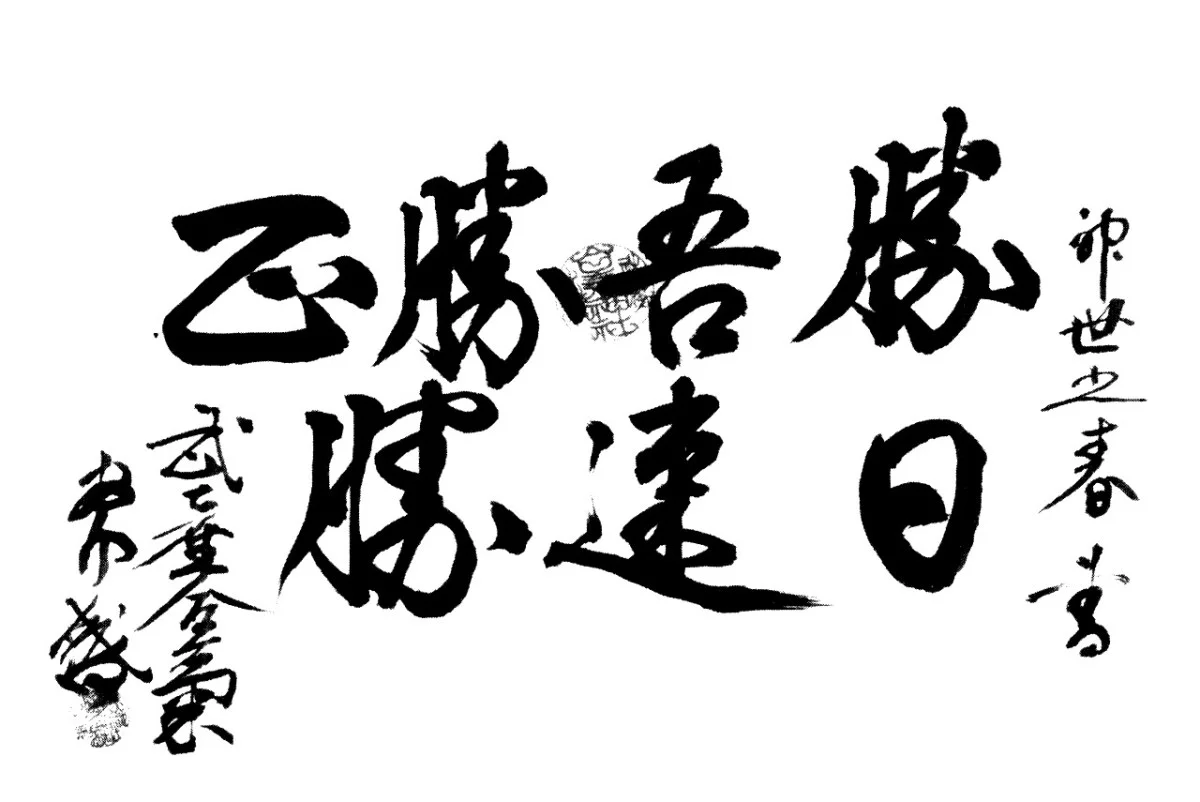
The Founder gave us a useful way to frame the greater challenge: Masakatsu Agatsu Katsuhayabi—true victory is self-victory. Before mastery can mean overcoming another person, it must mean learning to govern our own fear, ego, appetites, anger, and desire for control. The most important victory is not merely defeating an external threat. It is preventing that same destructive force from taking root within ourselves.
However, that external danger may be only the secondary threat.
The primary threat is that we develop the same mentality within ourselves—that we become selfish, dishonest, exploitative, or consumed by the desire to control others.
I have long believed that selfishness and the demand for instant gratification are among the most destructive human tendencies. They encourage us to place immediate desire above responsibility, truth, discipline, and the well-being of other people. Just as importantly, they encourage us to pursue what feels good in the present at the expense of our own future well-being. Many larger personal and social problems grow from those two impulses.
Aikido cannot remove them from human nature. It can give us a place to confront them.
Every time we train, we must decide whether to overpower our partner for the satisfaction of appearing strong or to work in a manner that permits both people to develop. We must decide whether to protect our ego or examine our weaknesses honestly. We must learn to exercise control without becoming controlling.
The first person our martial practice must teach us to govern is ourselves.
Different Ideals, Same Message
Erard and I may imagine the ideal society differently. We may disagree about competition, economics, politics, environmental concerns, and the proper relationship between individual responsibility and collective action.
Those disagreements do not invalidate his central insight about aikido.
Two people can begin from different philosophies and still reach the same conclusion: aikido does not need to prove itself as the ultimate method of street combat to possess tremendous value.
Its value can be found in awareness, composure, discipline, movement, judgment, and the ability to remain connected without surrendering our own stability. It can help us recognize conflict sooner and understand our role in escalating or resolving it. It can prepare us to act when action is necessary while reminding us that not every confrontation needs to be won through domination.
Aikido should still be practiced honestly. Its martial principles matter, and its techniques should not become empty choreography. But its effectiveness cannot be reduced to what we imagine we might do to another person during a fight.
A more meaningful measure is what our training enables us to become—and whether that person is more aware, more capable, more disciplined, and less likely to become either the victim or the source of unnecessary conflict.
Related reading: Aikido: The Study of Aiki and A Case for Keiko.
This article was inspired by and responds to a public post by Guillaume Erard, excerpted from an interview originally published in Karaté Bushido No. 458. This is an original commentary and does not reproduce or translate the complete interview.